
Deep kitchen drawers can be a double-edged sword.
On one hand, they offer cavernous amounts of potential storage capacity, perfect for bulky items that won’t fit in standard cabinets.
On the other hand, without an intentional system, they quickly devolve into dark, cluttered abysses.
If you find yourself digging through layers of kitchenware just to find a colander, it’s time to reclaim that valuable space.
Organizing a deep kitchen drawer requires a different strategy than a shallow one.
Let’s talk about a few creative deep kitchen drawer organization ideas you can try in your home.
But first, let’s explore how to prep them for optimization and organization.
Here’s a step-by-step guide to transforming your deep kitchen drawers from chaotic pits into organized havens.
Step 1: The Emptying and Editing Phase
You cannot organize a mess while it’s still inside the drawer.
Begin by removing absolutely everything from the drawers.
I recommend tackling one drawer at a time to prevent overwhelm.
As you pull items out, assess them honestly:
Do you need multiple salad spinners?
Have you used that immersion blender in the last two years?
Have the kitchen towels seen better days and are more ragged than rugged?
Donate or discard items you no longer need or want and clear out the clutter in this kitchen space.
Wipe down the interior of the empty drawer so you have a clean slate for the next step.
Step 2: Vertical Dividers for Support
This is the most crucial step for deep drawer management.
Because deep drawers have so much vertical height, the temptation is to stack things vertically.
It’s tempting to put a large frying pan on the bottom, a smaller one on top, and balance a saucepan on top.
But this “Jenga” approach makes accessing the bottom item impossible without removing everything above it.
And it makes keeping the drawer organized nearly impossible unless you load the drawer identically etc and every time.
To maximize space and ensure accessibility, resist stacking up and start filing sideways.
To do this effectively, you need dividers.
Deep drawer organizers, spring-loaded tension dividers, or adjustable peg-board systems act like walls within the cavernous space.
They transform one giant, unstable area into several smaller, structured compartments.
By using dividers to create narrower drawer sections, you create slots and necessary support for items to take advantage of the full depth of the drawer.
Suddenly, frying pans and pots can be stored on their sides, standing upright like files in a cabinet.
The dividers hold the cookware firmly in place vertically, making the items easy to access.
Step 3: Customizing Deep Kitchen Drawer Organization Ideas by Category
Once you have your dividers ready to create structure, it’s time to load the drawers based on what you need to store.
Pots and Pans
This is the most common use for deep kitchen drawers, especially those near the stove.

Use sturdy, tall tension dividers to create slots for store frying pans and sauté pans on their sides.
For deeper pots (like dutch ovens or stock pots), nest them with their lids flipped upside down so that the handle is inside.
Whenever possible, keep the lids together with the opt or pan to prevent needing to hunt it down later.

Install a heavy duty pegboard to keep large pots and pans from sliding around in the drawer when it’s opened or closed.
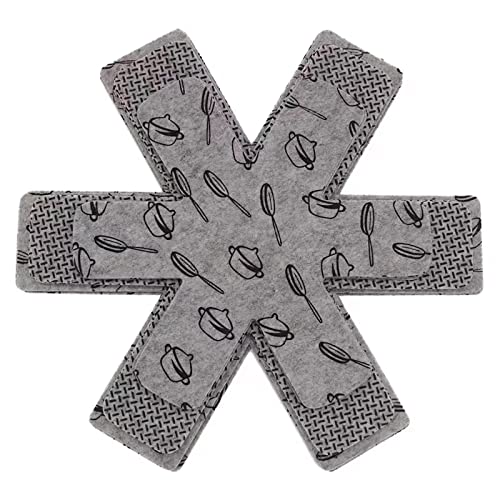
For eve stacked cookware, use felt pot protectors to safeguard the surface from scratches.
Dishes
Many modern kitchens are moving heavy stacks of ceramic plates out of upper cabinets and down into deep drawers.
This is ergonomically smarter, as you don’t have to lift heavy stacks overhead.

To keep the stacks from sliding around when opening and closing the drawer, use a peg-board system on the bottom of the drawer.
Position wooden or plastic pegs tightly around the stacks of plates and bowls to keep them secure.
Tupperware and Food Storage Containers
The “container drawer” is usually the most terrifying spot in the kitchen. The key here is containment within containment. Do not let lids float free. Nest your container bases by size.

Don’t bother with a smaller internal bin or a sectioned-off area created by a divider to “file” all the lids vertically, sorted by size.
Just match the lids and containers together so you can get out the set with one hand.
For more food storage container organization ideas, check out this post.
Small Kitchen Appliances
Hand mixers, mini food processors, immersion blenders, and waffle makers are bulky and awkward.
A deep drawer is a perfect home for them.
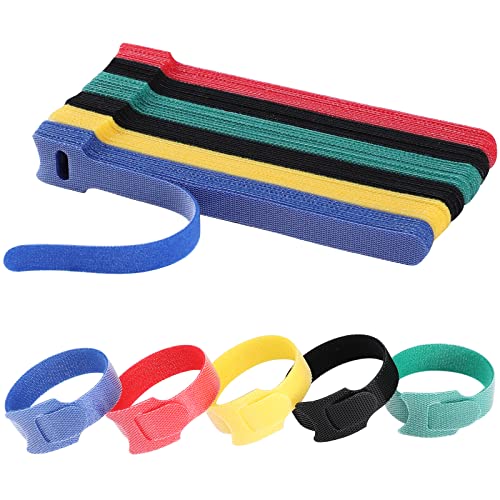
Bundle each cord with a hook and loop tie to ensure the appliances don’t get tangled up in the drawer.
Kid’s Dishes and Cups
If you have young children, dedicating a lower deep drawer for their items is a great way to keep everything in one place and support their independence.
They can easily reach their own plastic plates, bowls, and cups.
Because these items are usually durable and lightweight, you don’t necessarily need rigid organization here.
A couple of open-top bins placed inside the drawer can help separate cups from plates to keep it reasonably tidy.

This expandable drawer organizer instantly creates some structure for children’s dishes.
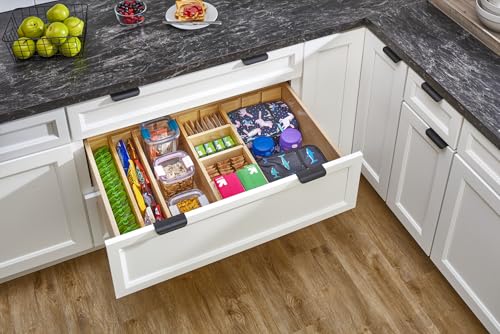
Snacks
Create a snack station in a deep kitchen drawer.
Rev-a-Shelf offers drawer insert that instantly creates divides sections that use the full depth of the drawer, ensuring items can be neatly stacked and piled in place.
Even without divided sections, you can still store bags of chips in a deep drawer.
Travel Mugs and Water Bottles
Travel mugs and tall water bottles are notorious for falling over in standard cabinets.

In a deep drawer, use dividers to create rows that are just wide enough for the bottles.
This provides vertical support, keeping them standing upright in neat rows, making it easy to grab your favorite mug or bottle.
For more ideas on organizing water bottles, check out this post.
Beverage Station
Deep drawers are excellent beverage stations, especially if you have a large collection of different coffee and tea options.
You can use small bins within the drawer to corral tea boxes, coffee pods, or bags of coffee beans.
If you have the space or if your collection depends it, you can devote a drawer to just coffee and tea.
If you have a smaller collection, combine the coffee and tea with the travel mugs for an all in one hot beverage station solution.

This customizable section divider allows for so many different options for creating distinct storage sections for deep kitchen drawer organization.
The possibilities makes it easy to take better advantage of the depth of the drawer so that items use the space vertically, rather than just spreading out horizontally.
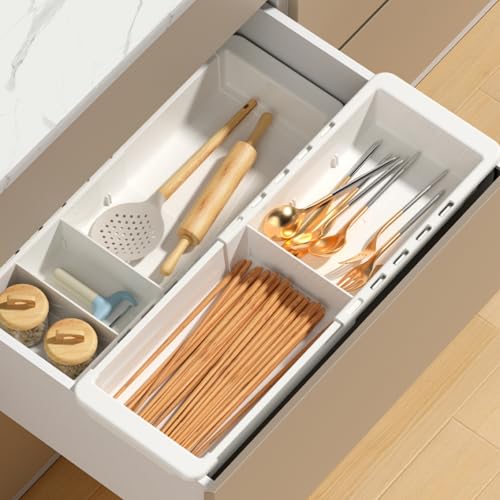
Utensils and Cooking Tools
When it comes to smaller items like utensils, silverware and cooking tools, the extra vertical space in a deep drawer can actually be a disadvantage.
If you simply place a standard, shallow cutlery tray at the bottom, you end up with several inches of wasted air above it—or worse, a “junk layer” that starts to accumulate on top of your forks and spoons.
To effectively manage utensils in a deep drawer, you need to think in layers or utilize the height for vertical standing.

- Tiered Sliding Organizers: This is the gold standard for deep utensil drawers.
You can install a double-tiered wood or plastic organizer where the top tray slides back and forth on a rail.
This allows you to keep your everyday silverware in the top “floating” tray while utilizing the bottom storage area for less-frequently used items like corn-on-the-cob holders, cake servers, or wine stoppers. - Vertical Cylinder Storage: If your drawer is deep enough, you can mimic the “crock on the counter” look but keep it hidden away.
Use tall, heavy-bottomed ceramic or metal cylinders to stand your long-handled tools—like spatulas, whisks, and ladles—straight up.
This prevents them from getting tangled together in a shallow heap and makes it easy to grab exactly what you need by the handle. - Deep Modular Bins: Instead of a single tray, use deep individual bins that take up the full height of the drawer.
Use long, narrow bins for “filing” wooden spoons and tongs, and smaller, deep cubes for things like measuring spoons or tea strainers.
This keeps items from migrating across the drawer every time you pull it open.

Kitchen Towels
Take advantage of every inch of space by adding a bin at the top of the drawer.
This is an ideal area to add a small number of kitchen towels in a handy location.
The organizer can easily slide out of the way to give access to items stored underneath.
Over to You
A deep drawer doesn’t have to be a black hole in your kitchen.
By using dividers to provide structure and embrace vertical storage, you can turn these large spaces into the most functional areas of your kitchen.
I hope you put one or more of these creative deep kitchen drawer organization ideas to use in your home!
Disclosure: I am a participant in the Amazon Services LLC Associates, the Container Store and Etsy Affiliate Programs, affiliate advertising programs designed to provide a means for sites to earn advertising fees by advertising and linking to Amazon.com, ContainerStore.com, and Etsy.com. This means that when you click and make a purchase at a site via a link I have provided, I make a small commission at no additional cost to you. Regardless of whether or not I receive a commission, I only recommend products that I personally use and genuinely recommend.


